
Introduction
Whether it is a formalised geologic epoch or not, the conditions of the Anthropocene are distinct from the past and everywhere seem to call for a new approach to education. The power of planetary forces to act back on humanity through processes of our own making and the densely networked, relational ontologies of being that define the age seem to require undergraduate students in university settings to make new observations, engage in new forms of dialogue, and generate new understandings that can lead to a different kind of ethics than has come before. But what exactly are we aiming for educationally? How do we get there, and how do we know if we have arrived? The current literature is dense on pedagogies and noticeably thinner in didactics or reported outcomes; scholars seem to have a strong sense of what is needed (Make kin! Be cautious! Go slow! Go wild!) but far less comprehensive recommendations for how to do this practically, intentionally, and effectively in the classroom.
Over the past several years, instructors and students from the John Martinson Honors College at Purdue University have experimented with methods to address this gap, and in this final contribution to Anthropocene ‘Interventions’, we report on our outcomes. Charting a path to our practices, in the section below the instructor first reflects on how to resolve an essential contradiction in Anthropocene education (Pocius, 2024)—the conflict between education’s commitment to the development of students as human beings (Bildung) and the posthumanist need in our present era to teach them that we do not exist independently of the natural world (ontological instability). It is proposed that new didactics might be formed by fostering an evolving resolution of this contradiction in the classroom, utilising the methods of archaeology. The following sections then describe how we attempted this in our classroom in 2024–2025. To demonstrate the outcomes that resulted, we present student work and offer suggestions about how these practices might be further improved upon in the future.
One (more) pedagogy of the Anthropocene
Both educational theory and practice have been enriched by the efforts of teachers of the Anthropocene, such that today there is no shortage of proposals for new pedagogies and many examples of how to realise them in the Anthropocene classroom (Bayley, 2018; Biesta, 2021; Clarke & Mcphie, 2024; Hjorth Warlenius, 2022; Kahn, 2010; Lysgaard et al., 2019; Max Planck Institute for Geoanthropology, n.d.; Paulsen et al., 2022; Snaza, 2013; Snaza & Weaver, 2015; Taylor & Bayley, 2019; Tsing et al., 2020). There is, however, a clear imbalance between these, with pedagogies far more prevalent in the scholarly literature than practical examples, and comparatively few didactics amounting to robust curricula. This disconnect between Anthropocene educational theory and practice creates a persistent and uncomfortable challenge in the classroom for teachers; we have a clear sense of a dire need to develop new forms of thinking, but relatively few guidelines for how to do this effectively, and even less of a sense of why we are equipping students with tools for new thinking because we do not know what they should do with these once acquired. Following Pocius (2024), we can understand this predicament as coming down to an essential contradiction: Anthropocene pedagogy does not fully relinquish humanism, while many of our practices work to throw it out entirely.
A case in point is the provocative and beautiful Feral Atlas (2020), a digital textbook that weaves and threads through artistic, ethnographic, spatial, and sonorous expressions of posthuman ecologies to provide a challenging set of case studies that document the Anthropocene. The atlas is a standout because it provides both an undeniably rich set of resources to advance student understanding and practical recommendations for classroom syllabi and activities. Its stated goals are ‘recognition and response’; however, its emphasis on vast, interconnected worlds captured in text and video is overwhelming. This overwhelm is sensorial, in that there is so much to take in descriptively, visually, and auditorily but little grounding in the form of things to be experienced materially; it is also political, in that the complexity and geography of world problems represented feels vastly out of reach for student action; and it is experiential, as navigating the site challenges learning to not get lost, or to lose meaning, as it follows the various threads of a hyper-interactive interface. In these ways, the atlas evocatively reproduces the world for student learning, but in doing so seems to likewise reproduce the alienation they experience in it.
Even attempting a more direct pathway towards recognition and response in my own Anthropocene classroom with personal reflective writing assignments, my students sensed a contradiction and pushed back (Brite et al., 2024). The students in these courses are honours undergraduates seeking interdisciplinary courses to complement their degree programs, the majority of which are technology-centred at our STEM-predominant university. These students were open to reading, writing, and sharing about their relational, posthuman experiences with hyperobjects (Morton, 2013) and other non-human things, but they were unwilling to concede that such recognition would reconfigure their own subjectivity, and they could not conceptualise how it might tangibly reform their actions in the world. Instead, they suggested an alternative pathway: that through deeper, and perhaps broader, pursuits of scientific knowledge, they would (admittedly) continue to enhance their power over others but also find new ways to define their ethics in relational ways, providing good guidance for their actions. I understood their idea of an expanded science to mean both an expansion of their empirical abilities and their rational explanatory power, geared towards understanding a weird, complex, and relational world (e.g., Stengers, 2018). Ultimately, they were willing to think about how they could be entwined with the non-human, or how they could be cyborgs, but it mattered little if it did not connect with how they would be agentive human beings.
Underlying this sentiment is what Pocius (2025) has identified as a parallax in Anthropocene education concerning its approach to students’ subjectivity. On the one hand, a normative understanding of human subjectivity is required to lead students to develop their ethics and sense of possibilities for social and political action; on the other, the imperative to open them to posthumanist ontologies alienates them from their central place of action and accountability in the world (see also Swyngedouw & Ernstson, 2018). The student reacts to this double bind by withdrawing (see “denial,” Lysgaard et al., 2019, pp. 8–9) because addressing the destruction of the world requires the destruction of their self. For the instructor, it can generate paralysis in the application of Anthropocene knowledge because the purpose, structure, and form of the educational mission exist in opposition to its content. To put it bluntly, just as my students do not come to class to relinquish their humanity, neither am I as an instructor tasked with teaching a world, a cat, a petrochemical, or a robot (yet). I am teaching them, and in doing so, I remain committed to the pedagogical pursuit of Bildung, the fundamentally Enlightenment concept of education for the development of a student’s personal sense of self and place in the world to generate ethics, care, criticality, and citizenship.
Attempts to reform Bildung for the Anthropocene advocate a move away from its modern sense of normative subjectivity and further, beyond the postmodern pursuit of plurality in emancipatory humanism, to realise a posthuman education that can reveal to students their more-than-human being (Blenkinsop & Wihelmsson, 2024; Friesen, 2022; Paulsen, 2021). Some recommended applications of this form of posthuman Bildung, however, seem too often to throw the baby out with the bathwater by requiring the rejection of all matter and context of teaching. For example, a common recommended approach is to get outside, walk, and go on excursions, but this is not feasible in many educational settings or possible for many kinds of students (Paulsen et al., 2022). In other examples, the recommended practices are narrowly biophilic and elevate relations with the living over relations with technological and other non-living beings, leaving students stranded when facing threatening ontologies like artificial intelligence (Lynch & Mannion, 2021). Where relating to the non-living is attempted, instructors seem to struggle with methods for making dialogue (Mcphie, 2018) or with addressing and resolving tensions (Niccolini et al., 2018), and while they can design classroom activities that co-create with technologies to demonstrate posthumanism, this forces a future imaginary not of the students’ own making (Arendt & Kohn, 2006, p. 177; Knochel, 2018; Pocius, 2025, p. 48).
A more promising avenue for reform may be the alternative concept of postdigital Bildung, which destabilises human subjectivities while still preserving the meaning and purpose of humanistic education. Here, as Rahm (2024) describes it, we start from the understanding that students cannot enter their struggle as objects first, only to become subjects later (Biesta, 2021; Freire, 2014; Hooks, 2014). Rather, postdigital Bildung commits to growing their subjectivity sideways, starting from themselves and moving outwards to access, acknowledge, and evaluate the lines of flight that draw them into material and ethical relations with others, both living and non-living (Deleuze & Guattari, 1987). Essentially, this entails a critical exploration of the ecology of their own subjective experiences. In doing so, it makes room for their techno-social worlds in totality, but in phenomenological ways that open them to reflecting on artefacts as externalised sources of knowledge and consciousness (Stiegler, 2018). The difference here, between a posthuman vs. postdigital Bildung, may seem slight and conceptual, but it is also practical and material—it produces a methodology whereby student and teacher can accurately account for the new realities of a highly digital, virtual, interconnected world, with its greater number of actors, variables, complexities, and uncertainties, and it asks students to trace these for themselves rather than receive them as wisdom from above, to do so expansively, with agency, care, and by means beyond automated or quantitative assessments. Put simply, it is a pedagogy of ‘handing back the pen’.
As suggested by the term, postdigital Bildung does forefront the exploration of digital technologies in the development of a student’s self and place in the world, and in doing so it may help to instantiate these into their personal growth towards ethics, care, criticality, and citizenship. An important distinction here, however, is to recognise that the ‘digital’ in postdigital Bildung is not understood to give priority to technological things, but rather to the empirical observation of the processes that permeate society (Kerres, 2021); it assumes that the digital is as real and expansive and agential as life, material being, and its analogues. It has affect, which integrates the virtual and the actual in the processes of becoming (Massumi, 2021). The shared task of instructor and student is to trace these process flows, and here the digital might be encountered as readily in the form of material hardware, software, social media relationships, automated production, artificial intelligence, or any other realisation of a binary-coded existence, along with all these entities’ non-digital counterparts and alternatives. The student may only partially know or understand these complex assemblages, and they are engaged in learning about them to the greatest extent that they can be revealed.
As a form of Bildung, postdigital Bildung maintains the commitment to the development of the human subject in the postdigital age by centring the student’s subjectivity as the base of learning outwards, and in this way, it can become a methodology through which students slowly define their relationships, ethics, ethical boundaries, purpose, intent, and eventually, actions in the world. This is essential, as it puts them in the driver’s seat (Arendt & Kohn, 2006). As with modern and postmodern conceptions of Bildung before it, postdigital Bildung also generates didactics that are diametrically opposed to skills-based learning (in the German terminology, Erziehung), asserting the ongoing mission of education to develop the human character. In the case of the postdigital, this is specifically contrasted to the learning of digital skills or technical competencies (e.g., learning how to code or prompt engineer; Guilherme, 2019; Jornitz & Klinge, 2022; Rahm, 2024). For this reason, we should expect that postdigital Bildung as an Anthropocene pedagogy will not take place everywhere; it must get under and infuse these practices rather than work through them, and it is rightly taught outside the bounds of (or alongside) a skills-based education.
Archaeological didactics for postdigital Bildung
If the Anthropocene demands students find grounding in the critical zone (Latour & Weibel, 2020), then we are repositioning education not as a practice based principally in discourse but extending it materially into an investigation of humanistic geology (Edgeworth et al., 2024; Walker et al., 2024). Archaeology is the discipline that supplies the essential tools for this practice, and we are tasked to apply it more exactly in the students’ material world. Take, for example, Foucault’s (2013) challenging discussion of AZERTY (French QWERTY)—a statement that is linguistically non-sensical but which operates intelligibly by its functional existence. AZERTY cannot be understood outside the corporate history that fashioned it, the constraints of the human body that engages it, or the physical systems of communication within which it operates. A student cannot understand the meaning of AZERTY without knowing the materiality of typing. But knowing it materially is also to understand its generative qualities, the possibilities it presents for creative expression, and faster speeds of communication (Mader, 2016). What more might be gained by looking at the wider frame of AZERTY’s functional existence? The patterns of skin oils and wear on the keyboards, the bits of lunch and bacteriological life spilled between the keys that make some of them stick. What further might these patterns reveal? What horizons and constraints does AZERTY present to the student for their communication and social relations transmitted via the virtual world?
Of course, this kind of thinking is not new (Barad, 2007; Bennett, 2020; Tsing, 2015), but the argument here is that archaeology provides essential tools we can utilise to fit the educational practice to the paradigm. Through methods of survey and excavation of the material world, archaeologists bring forth new understandings of human relationships with non-living and living things and define humanity’s place within Earth’s stratigraphy. To our benefit, this is also not a new line of thinking within the discipline of archaeology itself, which for the last several decades has deliberately considered how to apply archaeological methods to contemporary times to enhance learning about a stratigraphic layer that has a unique infusion of the virtual and the actual in the process of its formation (Buchli & Lucas, 2001; González-Ruibal, 2024; Graves-Brown et al., 2013; Harrison, 2011; Harrison & Schofield, 2009, 2010; Rathje, 2011; Rathje & Murphy, 2001; Schofield, 2010).
As a methodology, archaeology offers techniques for empirical observation that can be a powerful force for imagining things differently, but it is important to keep in mind that its data are not self-warranting (Chapman & Wylie, 2016). That is, things do not speak for themselves. Instead, the discipline uses various scientific methods to observe artefacts and assemblages in their contexts from a material record that is always incomplete, and from this, we make evidentiary claims about what exists (or existed) at any given time. Though the public tends to assume that the closest thing to an archaeologist is a historian, and academics might place them with either anthropologists or natural scientists, in fact, the closest analogy might be a criminal prosecutor.1 Archaeologists make their case for understanding conditions based on evidence collected from within a particular frame of time occurrence—the stratigraphic layer—and where needed, they demand justice (for the unacknowledged contributions of people, species, and artefacts to our life-world) based on credible claims. As archaeologists have long demonstrated, understanding humanity’s place in the past or present requires this context-specific, case-by-case study concretely grounded in reflexive analysis (Chapman & Wylie, 2016, p. 12). It is a set of tools that can be handed to students to allow them to litigate the conditions of the Anthropocene as they come to know them.
Application
We previously proposed a model of educational reform for the Anthropocene that students were open to engaging conceptually but found difficult to implement substantively (Brite et al., 2024 Figures 1 and 2). They wanted instead to document the real conditions in which they live and to pursue accurate descriptions of techno-scientific realities as part of their thinking. To address this, our previous model can be modified to insert the intended endpoint, embodied skill, earlier in the learning process (Figure 1). Embodied skill is the act of building the systems and structures of society (Rowson, 2019, p. 5). Positioning it at the end of the learning process situates it as a kind of outcome of a shift in values, or a form of fully realised civics, while assuming a foreclosed target for students’ practice. Alternatively, by embedding it within thinking, it becomes a kind of active learning about the students’ own intersubjective ontology and the vitality of non-human agents to inform their development. This also frees meaning-making to become an endpoint through which their actions in the world are guided.

Figure 1: Idealised stage progression of learning. Modified from Rowson (2019: 5).
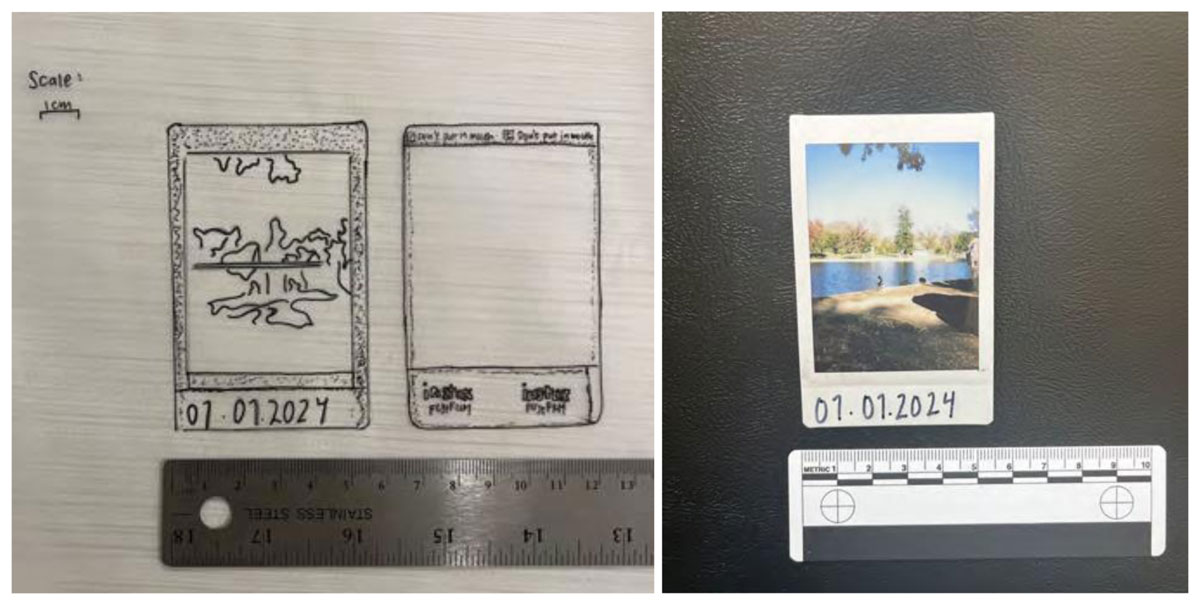
Figure 2: Archaeological illustration (left) and documentation photography (right) of a Polaroid photo.
To enact this embodied skill in our classroom, we applied methods from archaeology to contemporary artefacts selected by the students. Students were asked to choose an artefact that elicited some thought or emotion in them, or with which they in some way had a personal connection, whether that connection was utilitarian, symbolic, or simply situational. They then had to apply three archaeological methods for artefact analysis: (1) scientific illustration, (2) artefact life history and context research, and (3) museum curation.
For (1), students were trained in scientific illustration, beginning with a warm-up exercise to draw their smartphone, based on Morgan (2024). This allowed training time while also opening them to discussions about their intimacy with non-living things, the power of these in forming existence, and the challenges of making empirical observations about the virtual, fused with the actual (e.g., how do you document the content within the screen?) (see also Zanotti et al., 2018). Following this, they made their artefact choice, and in (2) they were required to create a scientific illustration and photograph of that artefact following archaeological drawing conventions (Adkins & Adkins, 1989; Griffiths et al., 2007) (Figures 2 and 3). They were required to research the artefact’s production origins, life history, context(s) of occurrence, and its impact as both artefact and symbol—defined with reference to Deleuze’s concepts of difference and repetition (Deleuze, 1994)—and were provided examples from Mitman et al. (2018) to follow. A final required step (3) was to bring their artefacts together in a class assemblage, curated as an exhibit with a museum label that interpreted the assemblage as an in situ deposit from contemporary stratigraphy (see Figure 4).
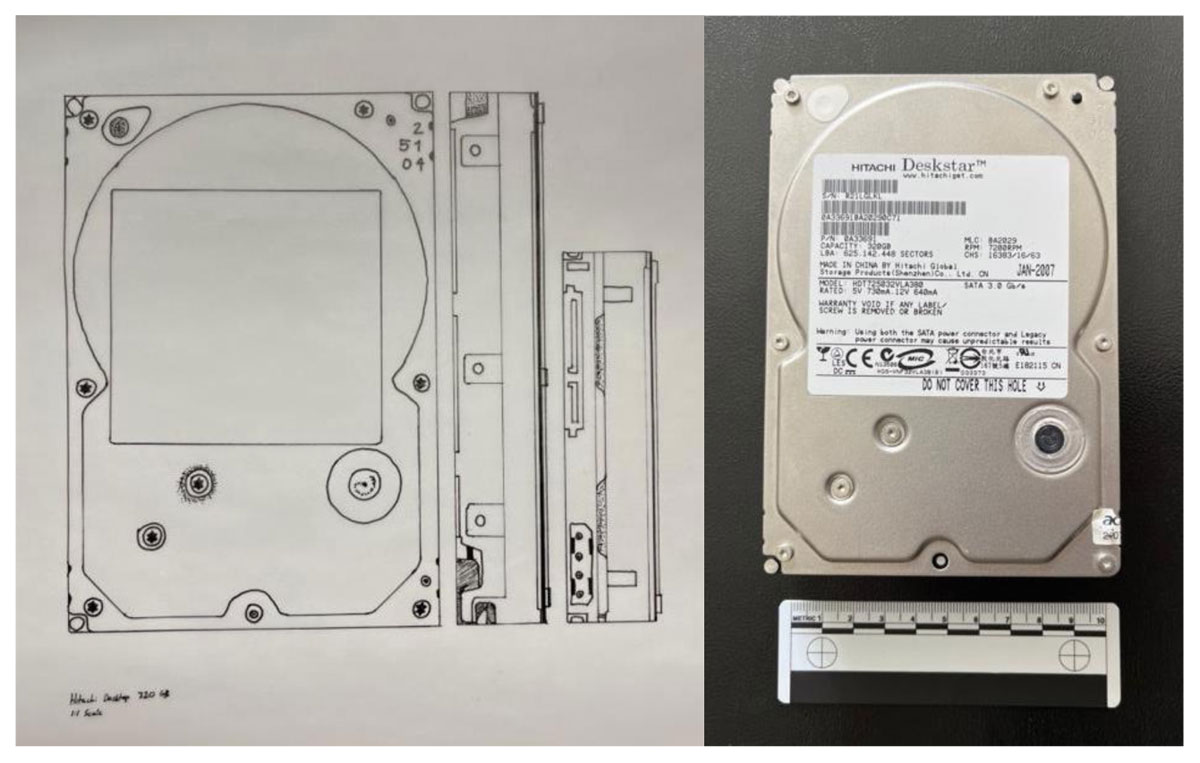
Figure 3: Archaeological illustration (left) and documentation photography (right) of a hard drive.
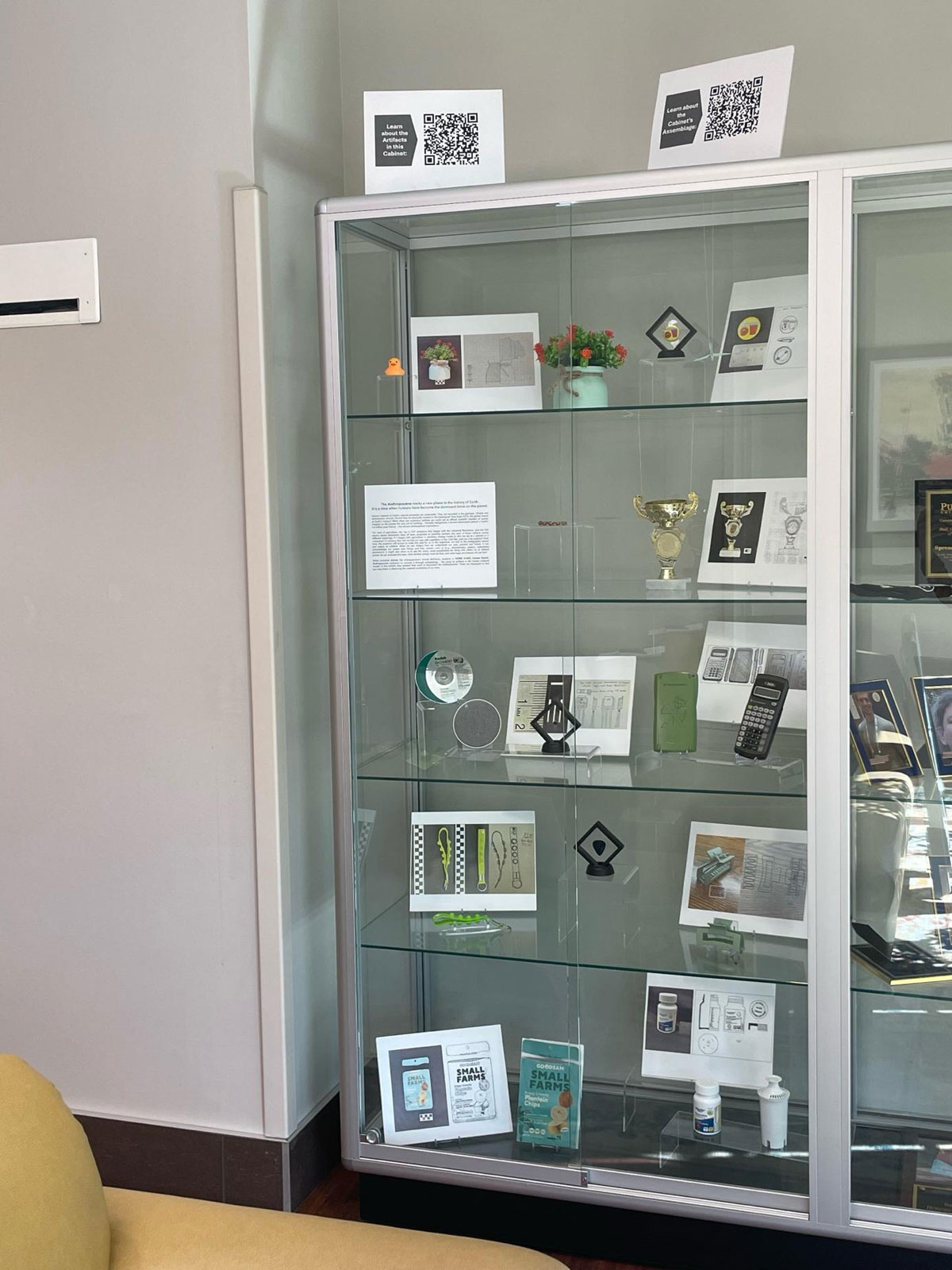
Figure 4: Assemblage exhibit 2025.
When this new content was first introduced in spring 2024, three students were selected to further develop their work. With grant funding from the John Martinson Honors College, we travelled to Chicago’s Field Museum to enhance their learning about the agency of artefacts in contemporary times. This work included meeting with a museum curator, who provided a tour of backroom collections to discuss ongoing disputes over cultural heritage, a discussion with the museum’s staff illustrator to learn more about the scientific documentation of artefacts, and a gallery exhibit exercise in which the students were asked to evaluate contemporary artefacts on display using conceptual frameworks from Lowenthal’s (2015) The Past is a Foreign Country, which considers how artefacts are used to make knowledge in the present. Following the trip, the three students were asked to review their original coursework and revise it as they felt was needed, taking into consideration the additional knowledge gained.
In the following section, their results are presented. Prasad and Sanborn each provide examples of artefact analysis, while Reynolds provides both analysis and summary reflections on the 2024 class assemblage. Final sections following these discuss the overall outcomes and future possibilities from our pedagogical practice.
Results
Ankita Prasad
Fourth-year JMHC student, Bachelor of Science in Chemical Engineering
Artefact: Polaroid photo
A photograph, because of its ability to capture a moment in time for eternity, is an artefact that resists the ways humans are constantly changing the world. Photographs memorialise a moment. The instant film photography of a Polaroid adds something significant to this practice. By design, its instantaneous and physical qualities made it an iconic social object of the mid-20th century, a thing meant to be shared (Ligueros, 2020, p. 32). Today, as an antique analogue, it captures a human moment in time with a specifically retrograde view of the evolution of technology. The Polaroid photograph is therefore a way in which to capture human experiences and to do so while fundamentally changing perspective—it is a retrogressive view of ourselves that impacts both the past and how we will view ourselves in the future.
The particular Polaroid photograph that I chose to examine as an artefact evokes a personal relationship, capturing a place that is emblematic of my home. It allows me to engage this place and time with a sense of nostalgia, to reflect on growing up and the experiences that have led me to the person that I am today. Considering it as an artefact of the Anthropocene, I cannot help but view it also in terms of the vastness of the effect that humans have had on the planet, the acceleration and obliteration of time that the Anthropocene introduces, and how an older technology, such as film imaging, can change this way of life.
The Polaroid, in terms of its materials, is made of plastic, a hyperobject embedded everywhere in our lives (Morton, 2013), and the image itself is produced through the reactions of various chemicals, including silver bromide and potassium thiosulfate, triggered by light. Though these are not the typical ‘forever chemicals’ characterised by polyfluoroalkyl compounds, the compounds used can still cause harm to the environment, and the plastic remains for long periods of time on the Earth since it does not degrade easily. But as a chemical engineering student, I am equally fascinated by the chemical reaction that occurs when light hits the chemicals in the Polaroid film to create a film emulsion and start the development process (McKay, 2023). The dye molecules become excited by the light and move around a gelatine layer, and the arrangement is then trapped in a clear layer, after which the final image can be seen. The ways that the molecules come together, triggered by the presence of light, allow for the image to be represented exactly like it is in our minds—the chemicals act as a bridge between the human and technological world. Furthermore, an alkaline compound (one with a pH > 7) accelerates the reaction, allowing it to develop within minutes. If the printed photo defines the way that we view the world, acting as an anchor for ‘the relationship within the self and between self and others’ (Tang & Li, 2022, p. 279), then the Polaroid extends these relationships to non-human, chemical others and in doing so expands and accelerates our social world. The Polaroid and its chemicals allowed us to document life as it happens and to examine events as they happened, offering a material affordance to ‘dislocate what once had been firmly grounded in space and time, entering objects, appearances, meanings, and memories into an ever-expanding system of exchange and circulation’ (Koepnick, 2004, p. 98). Platforms like social media followed and brought a vast amount of personal humanity, time, and space to people’s fingertips for exchange and circulation. This has proven to have significant consequences by allowing people to have access to more information but has also allowed for misinformation to be sown, the likes of which have never been experienced by humans before. Its chthonic cyborg properties, both horrid and beautiful, are now on display (D. Haraway, 2006; D. J. Haraway, 2020).
The important distinction between digital photos and film photos is that the former exist from a myriad of electronic data and mathematical formulae in abstracted time and space, which redefine what it means ‘to see’ (Koepnick, 2004, p. 98). The desire to bring back older technology such as the Polaroid can be attributed to the instability in the world that the Anthropocene brings about. People look back to material stability to feel a sense of comfort, to be able to see and feel differently. The digital age has forced the loss of the sensory element of touch traditionally associated with film cameras, and their resurrection seeks to restore the ‘visceral experiences of life that have been largely lost’ (Currie, 2022).
What then does it mean to illustrate a Polaroid that I took? There is no practical reason to do so, after all. The chemicals used in a Polaroid do not degrade easily over time, especially if stored properly (Boucher, n.d.), and the layer of the Polaroid that contains the photo itself is made from plastic, a technofossil (Edgeworth, 2021, p. 98; Zalasiewicz et al., 2014), further sealing the infinite fate of a human moment intentionally captured into geologic time. David Lowenthal (2015), in his book The Past is a Foreign Country—Revisited, describes how the nature of the past is something that humans are always seeking to understand, that we are always having to grapple with knowing how humans once behaved and how that informs the present. He explains that, however much humans are keen to study the past, ‘modernity threatens to strip the past of two hallowed values—enlightenment and empowerment’. This suggests that as time proceeds on, we are only left with pieces of what the past really was, and the things that are perceived can change with time. Enlightenment and empowerment are restored in the pursuit of certain key traits in relating to artefacts—familiarity, in determining how what we see in the past resembles what we have in the present; guidance, which tells us what to imitate and what to avoid; and possession, a claim of ownership of the past, of a heritage, of something to identify with. In drawing a Polaroid photo of a moment so highly personal to me, I re-acquainted myself with a deep contextual experience of my own past and re-discovered how that moment was meaningful and how it offered me a sense of comfort. Drawing it reclaims that possession, my heritage, and the slow and quiet embodied process of re-engagement, tracing lines and reforming its details, brought this into the world again, refreshed. In drawing it, I suggest that one thing and one act, working together, can create great societal and human change while also withholding it at the same time in the current geologic epoch.
Mikk Sanborn
JMHC Fourth-year student, Bachelor of Science in Computer Science
Artefact: old hard drive
Standalone hard drives do not do much for humans. We may think of them as a locked filing cabinet: they are simply sealed containers of information. And just like a locked filing cabinet, its inner components do not matter to us. Similarly, it does not matter to a computer if a drive is an HDD, SSD, or a floppy disk. The protocols they use are standardised (e.g., SATA and FAT32/NTFS), and we do not need to worry about how it works—only that it works.
As with many things in computer science, protocols are built as abstractions to hide the complex inner workings of components. It is only when they do not work that we become troubled by them. What happens to a hard drive when it is discarded or damaged? What happens to computer components as they fail, are upgraded, or get replaced? In the case of hard drives, this process of decay is twofold: the material drive (the physical component) will indefinitely remain in our world in some capacity, while the data on the drive (the digital component) have a more volatile future—they may remain intact or may degrade along with the physical component.
Its decay also makes apparent the significant time, effort, and specialised resources required to create a hard drive. In the case of hard-disk drives, this includes aluminium for the frame, plastics for casings or supports, silica for circuit boards, copper for wiring and data paths, metallic alloys for the disk that stores the data, and neodymium for the read/write head. This contrasts dramatically with the cost of writing data to these drives, which can be cheap and nearly instantaneous, and for which the cost of creating the data itself varies widely. Such data may be cheap and quick to create, like a blank Word document, or may be costly, like the results of expensive scientific computations that took weeks to develop on large computer clusters run over many hours. All data require some amount of human effort and digital processing to create, but once created, they can be easily moved, cheaply duplicated, and inconsequentially destroyed.
The hard drive I have came into my possession from a student organisation that hosts community events for a residence hall on my university campus. The drive was a component of a 2007 Acer desktop that was slow, outdated, and set to be thrown away. I asked to take it instead, and I removed the hard drive to see if I could recover its data. I found some old records (copied and returned to the hall club, then destroyed) before using the drive in another desktop. I did not use the drive for too long before deciding to upgrade to something faster. But the experience gave me pause; if I were to throw it away, could it someday be excavated and read?
While illustrating my drive, I noticed how precise much of it is. This is likely because it is fabricated by machines with high tolerances to ensure that the final product functions. After completing the illustration, I found it interesting that I only marked the physical aspects; I did not draw what was printed on the sticker on the surface. This created an interesting contrast for me between the physical form of the object and its informational and digital aspects. The ink on the sticker, much like the data stored on the internal disk, will likely fade before much of the rest of the object begins to break down. I also noticed the elements that remained exposed, especially the ports that allow the drive to be connected. This represents another layer in the abstraction of storage devices in computers. These ports are standardised across devices, so any drive meeting a certain standard will be able to communicate with any other device sharing that port. This can be used to quickly swap out one drive for another.
In thinking about the significance of my hard drive and the contrasts between its physical and digital components and how these decay, I was drawn to Andrew Reinhard’s (2015) description of an excavation of an Atari dump at a landfill in New Mexico. Through excavation, they documented the company’s attempt to destroy a digital artefact that had been overproduced and was a commercial flop. Games and consoles had been intentionally crushed and had their wires cut before being buried under concrete. It is striking how much effort they put into preventing anyone from obtaining free copies of their devices; yet in a way, by discarding them, Atari gave up its rights to the items themselves and any data that might persist within them. Some of these remains from the Atari dump excavation now belong to the Smithsonian Institution, illustrating an interesting technological trash-to-treasure transformation. It is as if they mangled a locked filing cabinet to prevent others from ever reading its contents…which may make us more interested in what they are hiding. Destroying the cartridges seems short-sighted because they somehow become valuable by doing so while disregarding the time, effort, and materials that went into producing them. This leaves the future archaeological potential for other consumer technologies as an open question: what will we be able to recover from our digital past?
Jordan Reynolds
Fourth-year JMHC Student, Bachelor of Science in Statistics
Artefact: Styrofoam cup and assemblage cabinet
As we approached the final assemblage of our modern artefact display, my classmates and I discussed its organisation. With objects ranging from cherished personal mementos, like Prasad’s photograph, to disposable items emblematic of modern culture, like Sanborn’s hard drive, we arranged our display in order of most to least valuable. As such, the organisation of the display was not just a matter of aesthetic arrangement; it was a reflection of our collective perceptions of worth.
What struck me most during its assemblage was the unanimity with which we prioritised the order of our artefact display, all agreeing that objects with sentimental significance held the highest value, while single-use items ranked lowest. In this moment, I found myself asking, ‘What defines value?’. Is value determined by the material composition of an object, its functional utility, or its emotional significance? Or does the assignment of value to material goods transcend these attributes and become personally related to our origin stories?
Thus, I began contemplating the worth of objects we usually consider trash. Take, for instance, the Styrofoam cup, placed at the bottom of the display and deemed of little value. I could not help but ponder the ramifications of its absence and envision a world stripped of all such convenience items. How drastically would modern life change without disposable items? Moreover, what broader social shifts might occur if society chose sustainability over convenience? Undoubtedly, the Earth would benefit from the re-evaluation of the human pursuit of convenience over long-term environmental sustainability. But this proposal is also wholly unrealistic, as single-use objects have permeated our lives completely.
In trying to render the Styrofoam cup in a scientific drawing, I took note of the object’s malleability. The cup retained accidental scratches from my nails, marks from my fingers, and dents from being stored in my backpack. The ever-changing nature of the object caused it to evolve as I handled it, making it nearly impossible to nail down a definitive representation on paper. What I found most fascinating was that in collecting these markings, I was in a way imprinted onto the artefact. The final weeks of my semester spent carrying and studying this piece of trash turned it into a narrative object that tells a story about its user—one where each scratch and dent reflects a moment of my life and gives the object a unique identity linked to human interaction.
In some ways, it feels silly to hyper-analyse my brief use of a piece of trash. It seems absurd to attribute great value to a Styrofoam cup simply because I used it. It remains a Styrofoam cup—a disposable object used briefly and then discarded. However, I found value in reflecting on how humanity interacts with the objects we encounter. This sense of detachment that I describe, the idea that the things we use are nothing more than what they are, is what allows us to dismiss our individual contributions to global change.
When thinking about the Anthropocene—this proposed new geologic period centred on human influence—we tend to distance ourselves from it. The Anthropocene discussion encapsulates the entirety of human–planet interaction: a depth of activity that feels entirely too large for any individual to meaningfully contribute to. This perspective, which we encountered in Kathryn Malerbi’s origin story (Brite et al., 2022), that of individual ‘smallness in relation to … world formation processes’ is brought into a different light when thinking of malleable objects like the cup. By leaving a mark on objects, we connect our personal narratives to global ones, reminding us that small-scale actions collectively shape the geological record to create large-scale change.
As such, what does it mean to have my interaction with this object entombed in the Earth’s stratigraphic record for millennia? While there is much of my personal experience that is captured and preserved in this object, there is a lot that is lost as well. The experiences that are tied to the object cannot be preserved. When these ‘data’ become part of the larger stratigraphic record, they merge with countless other human imprints, creating a narrative of our collective existence while losing the personal connection to my experience.
Consider, for example, what it might mean for someone in the future to stumble upon this item, to hold it in their hand, and to look over the marks that I have made. In that moment, the cup would cease to be just a piece of ancient trash; it would become a link between past and present. The future observer might wonder about the person who made these marks, piecing together a story from the clues left behind. They might speculate about my life, the world I lived in, and the values we held. In this way, the object serves as a bridge across time, one that is personal in nature. But, when placed in a larger assemblage such as the one my classmates and I assembled, this personal connection is diminished, and we tend to think more of the larger-scale implications of the preserved objects. The individual stories become part of a collective narrative, where the focus shifts from personal experiences to broader societal patterns and behaviours.
It is important to remember, when the shift from observing the individual to examining the whole of the society that they represent takes place, that it is the individual contribution that forms the collective. This duality of perspective—personal and collective—is what makes the study of artefacts so powerful. It allows us to connect intimately with individual human stories while also considering the larger implications of our collective actions. The Styrofoam cup, in its simplicity, embodies this duality. It is both a personal artefact with unique imprints and a piece of a larger puzzle that tells the story of the Anthropocene.
Outcomes assessment
In terms of the outcomes of the student work presented above, it is worth assessing specifically in each case how the student demonstrates moving through their thinking and embodied practice towards a realisation of valuing and meaning-making. Below, each student’s narrative is discussed in turn, and following, we share a few final thoughts on the future possibilities of this pedagogy for other classroom spaces and contexts.
Prasad’s analysis discusses the ways in which the photograph allows people to have more control over the passing of time. This is not by itself a new interpretation of photography; however, by dealing specifically and intimately with a single Polaroid photograph from her home, Prasad is able to think more directly about the specific object and its operation. As a result, she reveals an interplay between the Polaroid’s instant and antique qualities, and she clearly articulates the significance of its chemical reactions to her as a chemical engineer. This produces some insightful reflections that may inform her emerging ethical framework. For example, she observes how the chemicals and their independent relations serve as a bridge between human and technological worlds, placing her profession in a wider ecology of interrelations. She also connects the chemical reactions to the genesis of social media, showing how chemical engineering creates processes that infuse society, not just design solutions to engineering problems. The latter point also makes clear that there are both beneficial and harmful impacts from this, which demonstrates her understanding of complex and nuanced ethics. A final point is to note that she was able to express exactly why doing this archaeological practice was significant for her and how it created something new and valuable, because she had been equipped with a clear, explicit sense of what slow and deliberate attention to artefacts provides to knowledge creation (familiarity, guidance, possession (Lowenthal, 2015)).
Sanborn’s contribution grapples with the challenge of hard drive disposal, something he has clearly thought about prior to the class and taken up as practice, engaging data recovery as part of his expertise in computer science. There is a growing literature on the archaeology of hard drives and other consumer technologies that can be offered to students like Sanborn to further inform their thinking (Aycock, 2021; Morgan, 2022; Perry & Morgan, 2015; A. Reinhard, 2015, 2018; A. D. Reinhard, 2019). In citing one of these sources (Reinhard 2015), Sanborn identifies hard drive disposal as an inflection point when the contrast between a hard drive’s material value and its de-valuing of human labour becomes apparent. But the embodied act of illustrating his own hard drive in our class adds something more to his thinking. It leads him to an unintended replication of the same problem, where he almost reflexively omits the hard drive’s informational contents (represented on the sticker) while attending carefully to its precise materials and digital interfaces. While this result may have come about in part from time constraints on completing the assignment, it also forced a deliberate choice between the intricate details that he felt had to be documented and those that could be summarised or overlooked out of a recognition that they would not be preserved anyway. It ties him personally to the state of the problem, and it leads him to an essential question about whether such acts of disposal leave open the possibility for the future recovery of human values.
Reynolds provides yet another example of how engaging a contemporary artefact can open a process of non-directional, ethical learning, where in this case a Styrofoam cup has led her to think about her intimate attachments to the most undesirable form of trash (as she notes, a Styrofoam cup is not only disposable but also doubly disdainful because of the biopolitics of recycling). Referencing the pedagogical design, she also demonstrates how she was encouraged towards this thinking about valuing and meaning-making by the cabinet assemblage portion of the assignment, specifically. Reynolds tells us how the cabinet shelves forced a hierarchical ordering of the class’s artefacts, leading her to critical questions about material life in the Anthropocene—can the highest order of human values be materially based? And might we, in the context of accelerated obliteration, preserve what we value at the top by embedding it in the most objectionable but enduring forms of garbage at the bottom? The shelving allows Reynolds to problematise her Styrofoam cup’s relegation to the bottom shelf and to offer her intimate, corporeal engagements with it as justification for why it might rise higher. In this way, the format of museum display serves as an unexpected pedagogical device for structuring ethical thinking, and it is worth considering how alternative display options in different kinds of spaces might elicit other lines of thought (e.g., if students were to create an interactive exhibit or an exhibit in the round).
Future Possibilities
Hamilakis (2004, 2015) makes the point that teaching archaeology can be an important route to critical emancipatory pedagogy. The reason for this is that contemplating what exists in its most apparent, tangible, and concrete material form allows us to consider that things could be otherwise. ‘What relationships and assemblages of humans and other living and non-living beings came together to make this specific artefact in front of me what it is today?’ In addressing this question, students open a learning process through which they can identify the ephemeral networks an artefact freezes in place and time and begin to recognise the historical contingency of what exists in the world, whether they are contemplating an object from the deep past or from the recent present (Cobb & Croucher, 2014, 2020). It is a practice that resists the reductive quantification or abstraction of material life into transferable data and that seems expertly suited to the continued pursuit of Bildung in the postdigital age (Stiegler, 2018).
In our classroom, in addition to the narratives shared above, these practices have generated a number of unanticipated but worthwhile, critical discussions. For example, in spring 2025, one student’s fascination with and love for a Fairchild single N-channel MOSFET semiconductor from his first-year electronics class provided an opportunity to discuss the news of a recently approved semiconductor factory to be built in our town, against strong community opposition (Mohanty & McNeil, 2025). This led to an open conversation about the role of universities and industries in society and the weighing of excitement and concern regarding future possibilities. In other instances, students introduced AI into their reflective writing only to find that the final project required a kind of writing (about an artefact) that could not be AI-replicated, leading them to consider the impacts of technology on texts that interpret human life experiences. And in yet another example, a student surfaced the gender-differentiated status of everyone in the room by pointing out distinctions between those who regularly carried her artefact, a bottle of ibuprofen, in their backpacks and those who did not.
Archaeologists continue to develop novel methods for learning the contemporary era in similar ways (Moshenska, 2024). These are exceptionally valuable and accessible pedagogical practices for postdigital Bildung in the Anthropocene, but they remain somewhat limited in their application to discipline-specific circles of archaeology/anthropology and related fields. We have been provided an exceptional opportunity at Purdue University to experiment with these approaches with dedicated honours students deeply invested in STEM fields, where we have been able to test the relevance and value of such practices for students who might care deeply about our rapidly changing world but never take an anthropology or environmental studies course. Biesta (2021, p. 7) has said that the work of an educator should be aimed at giving students a fair chance at existence as subjects. It is our hope that by openly reflecting on our process to develop an emancipatory pedagogy based on archaeological practices, we might help to foster just such an agenda in teaching the Anthropocene.
Notes
- Admittedly, the personality type is a little different. ⮭
Acknowledgements
Funding from Purdue University’s Convergence Grant allowed us to travel to Chicago to examine materials and exhibits at the Field Museum. We want to sincerely thank the Field Museum’s curator and associate director of anthropology, William Parkinson, for welcoming us so warmly to his institution and providing us a phenomenal opportunity to consider the operation of archaeological artefacts in contemporary society. We are also extremely grateful to the Field Museum’s staff illustrator, Jill Seagard, who graciously accepted our very strange request and gave us much deeper insight into how to examine and document material remains. These engagements greatly enhanced our thinking, writing, and the pedagogical practices detailed herein. We also wish to thank all the students enrolled in HONR 31400: The Anthropocene in 2024 and 2025 who are otherwise not listed as authors for their many contributions to class discussions. Thank you also to the editorial team of Anthropocenes: Human, Inhuman, Posthuman for the continued support of this work, and to the anonymous reviewers for valuable feedback that helped us to further improve the manuscript.
Competing Interests
The authors have no competing interests to declare.
Author Contributions
All authors contributed written portions of the text, as indicated in the section headings. All authors also equally contributed to the review and editing of the draft and final manuscript.
References
Adkins, L., & Adkins, R. (1989). Archaeological Illustration. Cambridge: Cambridge University Press.
Arendt, H., & Kohn, J. (2006). Between Past and Future. New York: Penguin Books.
Aycock, J. (2021). The Coming Tsunami of Digital Artefacts. Antiquity, 95(384), 1584–1589. http://doi.org/10.15184/aqy.2021.142
Barad, K. (2007). Meeting the Universe Halfway: Quantum Physics and the Entanglement of Matter and Meaning. Durham, NC: Duke University Press.
Bayley, A. (2018). Posthumanism, Decoloniality and Re-Imagining Pedagogy. Parallax, 24(3), 243–253. http://doi.org/10.1080/13534645.2018.1496576
Bennett, J. (2020). Vibrant Matter: A Political Ecology of Things. Durham, NC: Duke University Press.
Biesta, G. (2021). World-Centered Education: A View for the Present. New York: Routledge.
Blenkinsop, S., & Wihelmsson, L. (2024). Ecologizing Bildung: Educating for the Eco-Social-Cultural Challenges of the Twenty-First Century. Canadian Journal of Environmental Education (CJEE), 26, 102–118.
Boucher, V. (n.d.). How long do Polaroids last? EverPresent. Accessed 24 September 2025: everpresent.com/how-long-do-polaroids-last/#:~:text=Just%20like%20any%20other%20photo,become%20distorted%20over%20the%20years
Brite, E. B., et al. (2022). Refashioning Origins in the Anthropocene: Reflections on Pedagogical Practice. Anthropocenes–Human, Inhuman, Posthuman, 3(1): 6. http://doi.org/10.16997/ahip.1293
Brite, E. B., et al. (2024). Refashioning Origins in the Anthropocene II: Facing Hyperobjects as Pedagogical Practice. Anthropocenes–Human, Inhuman, Posthuman, 5(1), 2. http://doi.org/10.16997/ahip.1491
Buchli, V., & Lucas, G. (2001). Archaeologies of the Contemporary Past. 1st Edition. New York: Routledge.
Chapman, R., & Wylie, A. (2016). Evidential Reasoning in Archaeology. Debates in Archaeology. London: Bloomsbury Academic.
Clarke, D. A. G., & Mcphie, J. (2024). New Materialisms and Environmental Education. London: Routledge.
Cobb, H., & Croucher, K. (2014). Assembling Archaeological Pedagogy. A Theoretical Framework for Valuing Pedagogy in Archaeological Interpretation and Practice. Archaeological Dialogues, 21(2), 197–216. http://doi.org/10.1017/S138020381400021X
Cobb, H., & Croucher, K. (2020). Assembling Archaeology: Teaching, Practice, and Research. Oxford: Oxford University Press.
Currie, B. (2022). Gen Z finds stability by embracing the past. Forbes. May 25, 2022. Accessed February 18, 2026. https://www.forbes.com/councils/forbestechcouncil/2022/05/24/gen-z-finds-stability-by-embracing-the-past/.
Deleuze, G. (1994). Difference and Repetition. New York: Columbia University Press.
Deleuze, G., & Guattari, F. (1987). A Thousand Plateaus: Capitalism and Schizophrenia. Minneapolis, MN: University of Minnesota Press.
Edgeworth, M. (2021). Transgressing Time: Archaeological Evidence in/of the Anthropocene. Annual Review of Anthropology, 50(1), 93–108. http://doi.org/10.1146/annurev-anthro-101819-110118
Edgeworth, M., et al. (2024). The Anthropocene Is More than a Time Interval. Earth’s Future, 12(7), e2024EF004831. http://doi.org/10.1029/2024EF004831
Foucault, M. (2013). Archaeology of Knowledge. 2nd Edition. New York: Routledge.
Freire, P. (2014). Pedagogy of the Oppressed. 30th Anniversary Edition. London: Bloomsbury Academic.
Friesen, N. (2022). Education and Bildung in the Anthropocene: Responding to COVID-19. In E. Krogh, A. Qvortrup, & S. T. Graf (Eds.), Bildung, Knowledge, and Global Challenges in Education. London: Routledge.
González-Ruibal, A. (2024). An Archaeology of the Contemporary Era. London: Routledge.
Graves-Brown, P., Harrison, R., & Piccini, A. (2013). The Oxford Handbook of the Archaeology of the Contemporary World. Oxford: Oxford University Press.
Griffiths, N., Jenner, A. and Wilson, C. (2007). Drawing Archaeological Finds: A Handbook. London: Archetype Books.
Guilherme, A. (2019). Considering AI in Education: Erziehung but Never Bildung. In J. Knox, Y. Wang, & M. Gallagher (Eds.), Artificial Intelligence and Inclusive Education: Speculative Futures and Emerging Practices (pp. 165–178). Singapore: Springer Nature.
Hamilakis, Y. (2004). Archaeology and the Politics of Pedagogy. World Archaeology, 36(2), 287–309. http://doi.org/10.1080/0043824042000261031
Hamilakis, Y. (2015). Archaeology and the Logic of Capital: Pulling the Emergency Break. International Journal of Historical Archaeology, 19(4), 721–735. http://doi.org/10.1007/s10761-015-0307-4
Haraway, D. (2006). A Cyborg Manifesto: Science, Technology, and Socialist-Feminism in the Late Twentieth Century. In S. Stryker & S. Whittle (Eds.), The Transgender Studies Reader (pp. 103–118). London: Routledge.
Haraway, D. J. (2020). Staying with the Trouble: Making Kin in the Chthulucene. Durham, NC: Duke University Press.
Harrison, R. (2011). Surface Assemblages. Towards an Archaeology in and of the Present. Archaeological Dialogues, 18(2), 141–161. http://doi.org/10.1017/S1380203811000195
Harrison, R., & Schofield, J. (2009). Archaeo-Ethnography, Auto-Archaeology: Introducing Archaeologies of the Contemporary Past. Archaeologies: Journal of the World Archaeological Congress, 5(2), 185–209. http://doi.org/10.1007/s11759-009-9100-5
Harrison, R., & Schofield, J. (2010). After Modernity: Archaeological Approaches to the Contemporary Past. Oxford: Oxford University Press.
Hjorth Warlenius, R. (2022). Learning for Life: ESD, Ecopedagogy and the New Spirit of Capitalism. The Journal of Environmental Education, 53(3), 141–153. http://doi.org/10.1080/00958964.2022.2070102
Hooks, B. (2014). Teaching to Transgress. London: Routledge.
Jornitz, S., & Klinge, D. (2022). Bildung’ as a Forgotten Aspect of Algorithmic Technologies. In M. Parreira do Amaral & C. Thompson (Eds.), Geopolitical Transformations in Higher Education: Imagining, Fabricating and Contesting Innovation (pp. 231–249). Cham, Switzerland: Springer International Publishing.
Kahn, R. V. (2010). Critical Pedagogy, Ecoliteracy, & Planetary Crisis: The Ecopedagogy Movement. Vol. 359. Lausanne, Switzerland: Peter Lang.
Kerres, M. (2021). Bildung in a Digital World: The Social Construction of Future in Education. In D. Kergel, M. Paulsen, J. Garsdal, & B. Heidkamp-Kergel (Eds.), Bildung in the Digital Age. 1st Edition (pp. 29–46). London: Routledge. http://doi.org/10.4324/9781003158851-4
Knochel, A. D. (2018). Drawing Together and Falling Apart. Parallax, 24(3), 295–305. http://doi.org/10.1080/13534645.2018.1496580
Koepnick, L. P. (2004). Photographs and Memories. South Central Review, 21(1), 94–129. http://doi.org/10.1353/scr.2004.0009
Latour, B., & Weibel, P. (2020). Critical Zones: The Science and Politics of Landing on Earth. Cambridge, MA: MIT Press.
Ligueros, A. L. (2020). Resisting Obsolescence: Polaroid Practices in the ‘Digital Age’. PhD dissertation. London: University College London.
Lowenthal, D. (2015). The Past Is a Foreign Country–Revisited. Cambridge: Cambridge University Press.
Lynch, J., & Mannion, G. (2021). Place-Responsive Pedagogies in the Anthropocene: Attuning with the More-than-Human. Environmental Education Research, 27(6), 864–878. http://doi.org/10.1080/13504622.2020.1867710
Lysgaard, J. A., Bengtsson, S., & Laugesen, M. H.-L. (2019). Dark Pedagogy. Cham, Switzerland: Springer.
Mader, M. B. (2016). The Regularities of the Statement: Deleuze on Foucault’s Archaeology of Knowledge. In N. Morar (Ed.), Between Deleuze and Foucault. Edinburgh: Edinburgh University Press.
Massumi, B. (2021). Parables for the Virtual: Movement, Affect, Sensation. Second Edition. Durham, NC: Duke University Press.
Max Planck Institute of Geoanthropology. (n.d.). Anthropocene Commons. Accessed 14 September 2025. https://www.anthropocene-curriculum.org/anthropocene-commons#
McKay, P. (2023). The magic of instant photography: how Polaroid film works. Analogue Wonderland, April 12, 2023. Accessed February 18, 2026. https://analoguewonderland.co.uk/blogs/film-photography-blog/how-polaroid-film-works?srsltid=AfmBOop5sIspjuoEGwIIVpv8tgEUiHN7H4_RPVjSm6VnGR2l6a-uj64h
Mcphie, J. (2018). I Knock at the Stone’s Front Door: Performative Pedagogies beyond the Human Story. Parallax, 24(3), 306–323. http://doi.org/10.1080/13534645.2018.1496581
Mitman, G., Armiero, M., & Emmett, R. S. (2018). Future Remains: A Cabinet of Curiosities for the Anthropocene. Chicago: University of Chicago Press.
Mohanty, R., & McNeil, J. (2025). SK Hynix Rezone approved 6-3 by West Lafayette City Council after marathon meeting. The Exponent (West Lafayette, Indiana), May 6, 2025. https://www.purdueexponent.org/city_state/general_news/sk-hynix-rezone-council-meeting/article_1a626db2-e9a8-4a13-bca3-1f5ce17573ac.html
Morgan, C. (2022). Current Digital Archaeology. Annual Review of Anthropology, 51(1), 213–231. http://doi.org/10.1146/annurev-anthro-041320-114101.
Morgan, C. (2024). Draw Your Phone: The Cellphone as Intimate, Everyday Artefact. In G. Moshenska (Ed.), Teaching and Learning the Archaeology of the Contemporary Era (pp. 101–112). London: Bloomsbury Academic.
Morton, T. (2013). Hyperobjects: Philosophy and Ecology after the End of the World. Minneapolis, MN: University of Minnesota Press.
Moshenska, G. (2024). Teaching and Learning the Archaeology of the Contemporary Era. London: Bloomsbury Publishing.
Niccolini, A. D., Zarabadi, S., & Ringrose, J. (2018). Spinning Yarns: Affective Kinshipping as Posthuman Pedagogy. Parallax, 24(3), 324–343. http://doi.org/10.1080/13534645.2018.1496582
Paulsen, M. (2021). Cautiousness as a New Pedagogical Ideal in the Anthropocene. In K. B. Petersen et al. (Eds.), Rethinking Education in Light of Global Challenges (pp. 220–233). London: Routledge.
Paulsen, M., Jagodzinski, J., & Hawke, S. M. (2022). Pedagogy in the Anthropocene: Re-Wilding Education for a New Earth. Cham: Springer Nature.
Perry, S., & Morgan, C. (2015). Materializing Media Archaeologies: The MAD-P Hard Drive Excavation. Journal of Contemporary Archaeology, 2(1), 94–104. http://doi.org/10.1558/jca.v2i1.27083
Pocius, A. (2024). Education as Performative Contradiction: Limits (and Possibilities) of Subjectification in the Anthropocene. Acta Paedagogica Vilnensia, 53, 42–56. http://doi.org/10.15388/ActPaed.2024.53.4
Rahm, L. (2024). Bildung: An Exploration of Postdigital Education in the Anthropocene. In Buch, A., Lindberg, Y., & T. C. Pargman (Eds.), Framing Futures in Postdigital Education: Critical Concepts for Data-Driven Practices (pp. 119–137). Cham: Springer Nature. http://doi.org/10.1007/978-3-031-58622-4_7
Rathje, W. (2011). Archaeological Intervention in the Past, Present and Future Tense. Archaeological Dialogues, 18(2), 176–80. http://doi.org/10.1017/S1380203811000249
Rathje, W., & Murphy, C. (2001). Rubbish!: The Archaeology of Garbage. Tucson, AZ: University of Arizona Press.
Reinhard, A. (2015). Excavating Atari: Where the Media Was the Archaeology. Journal of Contemporary Archaeology, 2(1), 81–85. http://doi.org/10.1558/jca.v2i1.27108
Reinhard, A. (2018). Archaeogaming: An Introduction to Archaeology in and of Video Games. New York: Berghahn Books.
Reinhard, A. D. (2019). Archaeology of Digital Environments: Tools, Methods, and Approaches. PhD dissertation. Heslington: University of York.
Rowson, J. (2019). Bildung in the 21st Century—Why Sustainable Prosperity Depends upon Reimagining Education. In CUSP Essay Series on the Morality of Sustainable Prosperity, No 9. Guildford: Centre for the Understanding of Sustainable Prosperity. https://cusp.ac.uk/themes/m/essay-m1-9/
Schofield, J. (2010). Archaeology and Contemporary Society: Introduction. World Archaeology, 42(3), 325–327. http://doi.org/10.1080/00438243.2010.497335
Snaza, N. (2013). Bewildering Education. Journal of Curriculum and Pedagogy, 10(1), 38–54. http://doi.org/10.1080/15505170.2013.783889
Snaza, N., & Weaver, J. A. (2015). Posthumanism and Educational Research. Vol. 35. New York: Routledge.
Stengers, I. (2018). Another Science Is Possible. Translated by Stephen Muecke. Cambridge, UK: Polity.
Stiegler, B. (2018). The Neganthropocene. London, UK: Open Humanities Press.
Swyngedouw, E., & Ernstson, H. (2018). Interrupting the Anthropo-obScene: Immuno-Biopolitics and Depoliticizing Ontologies in the Anthropocene. Theory, Culture & Society, 35(6), 3–30. http://doi.org/10.1177/0263276418757314
Tang, L., & Li, Q. (2022). Research on the Relationships Between Humans and Printed Photos in the Digital Era. Lecture Notes in Computer Science (pp. 268–282). Cham: Springer. http://doi.org/10.1007/978-3-031-06047-2_19
Taylor, C. A., & Bayley, A. (2019). Posthumanism and Higher Education: Reimagining Pedagogy, Practice and Research. Cham: Springer Nature.
Tsing, A. L. (2015). The Mushroom at the End of the World: On the Possibility of Life in Capitalist Ruins. Princeton, NJ: Princeton University Press.
Tsing, A. L., et al. (2020). Feral Atlas: The More-than-Human Anthropocene. Redwood City, CA: Stanford University Press.
Walker, M., et al. (2024). The Anthropocene Is Best Understood as an Ongoing, Intensifying, Diachronous Event. Boreas, 53(1), 1–3. http://doi.org/10.1111/bor.12636
Zalasiewicz, J., et al. (2014). The Technofossil Record of Humans. The Anthropocene Review, 1(1), 34–43. http://doi.org/10.1177/2053019613514953
Zanotti, L., Cooper, H. K., & McMullen, S. (2018). Teaching electronic life histories. Fieldsights, Society for Cultural Anthropology, December 14, 2018. https://www.culanth.org/fieldsights/teaching-electronic-life-histories