

Introduction
The Arctic coastline, to the extent that it is singular at all, is a concatenation of specificities. One can find patterns in its rich regional interdependencies, histories, and cycles but cannot think from its ontology or measure its implicate order. It is a dynamic assemblage of relationships that take shape only in material-semiotic encounters among more-than-human actants, situated variously on its lawscape, the folded, patterned, and striated plane of normativity (Philippopoulos-Mihalopoulos 2014). The Arctic coastal lawscape is not merely defined by doctrinal or even human normativity, encapsulated in the legislation and jurisdictions of state agencies. Rather, it draws together extremes of light and temperature, dramatically metabolizes energy across phases of matter, and bursts with life during periods of productivity, creating permissions and prohibitions on movement, growth, and (in)visibility: in the poles, seasonal transition has, for millennia, been a reliable rupture and profound transformation, marking openings and closings of socionatural possibility, unrivaled nearer the equator. But seasons are now rupturing internally, new seasons emerge, and phase shifts become increasingly precarious (Smith and Liu 2025). The Arctic’s coastal lawscape erodes at one end and replenishes at the other, or, in some cases, erodes at both ends and accretes in the middle. One particular actant insists on the latter, deterritorializing latitudinally and genetically: on one end, a polar bear, Ursus maritimus, stalking seals, swimming, and scavenging the icy ocean; on the other end, a grizzly bear, Ursus arctos, snapping up salmon, sleeping, and scouting the boreal coasts (Figure 1). In between, a body emerges, de- and recoding both species. Nanulak1 (a grolar or pizzly bear) makes a solitary journey across the Arctic biome in flux.
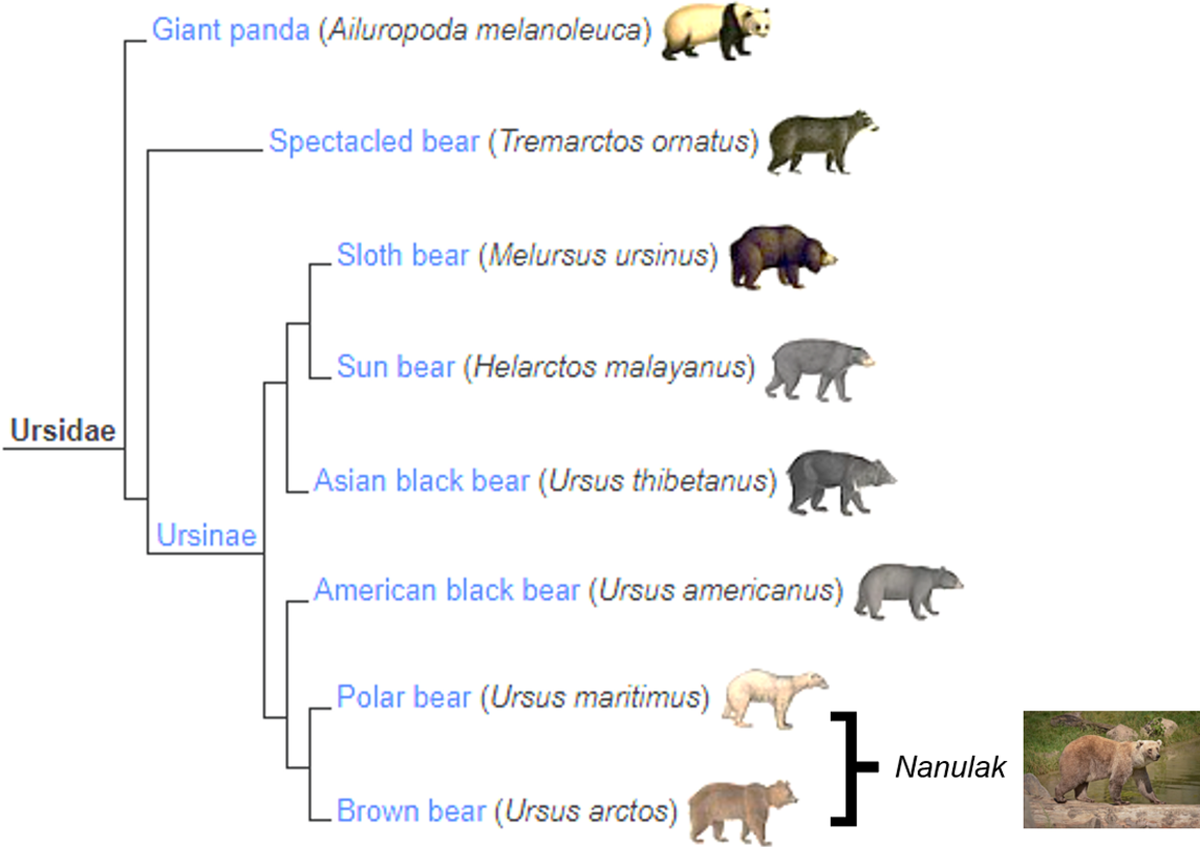
Figure 1: The arborescent structure of the Ursidae phylogenetic tree, deterritorialized by Nanulak, disrupting the branch-like arborescence of phylogeny to form the beginning of a rhizome, a new structuration of multiplicity and entanglement (original phylogenetic tree from Wikipedia creative commons; Nanulak photo from DeviantArt creative commons).
This intervention seeks to mimic rather than demystify Nanulak and her northern coasts, ‘staying with the trouble’ (Haraway 2016) of emergent hybridity by itself becoming hybrid, blurring disciplinary, stylistic, and theoretical boundaries. We, diverse, contemporary humans, must conceive of our changing place in the web of life without semantically reasserting exceptionalism, a creative act of submission to planetary authority and pluriversality. To eschew such control at a time when some Anthropocene studies camps suggest the opposite—authoritarian fantasies of geoengineering, genetic tinkering, and green colonialism—is the desired outcome of this hybridity. Nanulak, as I will show, is both complete and incomplete, clumsy and magnificent, a poor evolutionary fit who will nonetheless multiply. Her home is vast, slushy, and unpredictable, a thawing land that ebbs and flows. Her condition is, in fact, our condition. She is thus both a subject and a model of Anthropocene governance, the process of resolving how power is distributed across bodies and spaces. Such governance must be conceived non-reductively, as contested, normative relationality among more-than-human beings and their sociomaterial practices (Briassoulis 2019; Davies et al. 2021). Like those scholars who have sought to ‘think from the border’ (Mignolo and Tlostanova 2006) to challenge imperial partitions of knowledge and bodies, this paper tries to think from a ‘border being’ and investigate the decolonial, anti-hegemonic possibilities it bears with it. Governing Arctic coasts can no longer afford the assumption of imperial, managerial control or stability. What follows is a ‘carrier bag’ (Le Guin 1996) for the possibilities of becoming with maritimus-arctos.
Portrait of a Hybrid
Observing the Arctic’s changing temporalities, Demuth (2019, 317) asks, ‘What happens when not three warm seasons worry a caribou herd, but thirty in a row? When walruses must birth on beaches rather than their floating coast? And what of the iceless shores where polar bears now meet grizzlies and between them breed strange new creatures: perhaps fit for a warmer age, perhaps unfit for any’. Nanulak, this hybrid offspring of arctos and maritimus, can help map the Anthropocene Arctic to materially and semiotically ground what kind of socionatural futures are at stake in how communities live, know, and govern on the coast. She represents the possibility of new norms and new patterns but is, as yet, a mere bend in the rules. Nanulak is not a system, nor is she part of one. Her existence is a rupture. Her intergenerational survival is an anomaly until it isn’t. Her hybridity has emerged in/from/as the Anthropocene, but speciation must wait for the future’s impoverished taxonomists. Strange and out of place (Figures 2 and 3), Nanulak assembles as she moves across the lawscape but is not yet ready to join an assemblage. She is, rather, only herself, clambering along a line of flight.
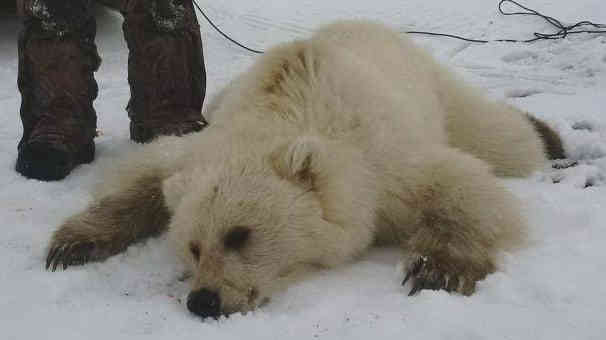
Figure 2: Nanulak, killed near Arviat, Nunavut, in 2016. (Photo by Didji Ishalook, published by CBC, URL: https://www.cbc.ca/news/canada/north/grizzly-polar-bear-hybrid-arviat-nunavut-1.3586738).
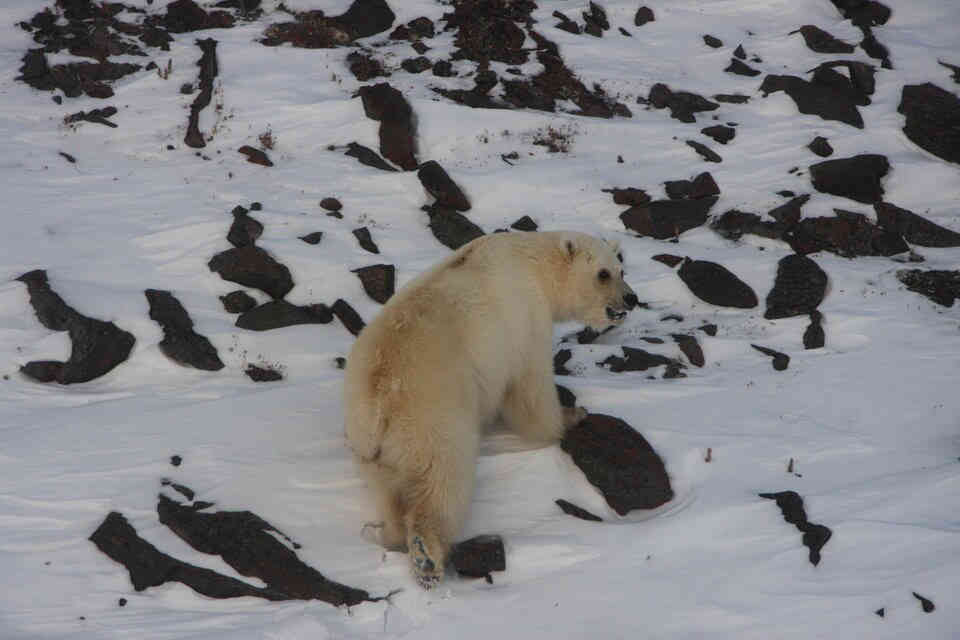
Figure 3: Nanulak, seen near the Viscount Melville Sound in 2012. (Photo by Jodie Pongracz/Government of the Northwest Territories, URL: https://www.richmond-news.com/highlights/grolar-hybrid-bears-confirmed-in-canadian-study-9080567).
Nanulak consists of at least eight ‘wild’ individuals (Pongracz et al. 2017), representing a new type of entity comparable in population to animals near extinction. Since 2004, grizzly bears have been observed hundreds of miles north of their traditional habitat range, trekking onto the sea ice where, if not food, opportunities for interacting and mating with polar bears are available (ibid.). This phenomenon is known in evolutionary biology as sympatry, the formation of either robust or narrow ‘hybrid zones’ where genetic exchange occurs among species (Barton 2001). Interspecies mating among mammals is rare, with most notable examples (mules, ligers, and coydogs) typically resulting from human intervention. In ‘the wild’, Nanulak (all eight of her) comes from only one maritimus mother and two arctos fathers (ibid.). Unlike nearly all other interspecies mammal offspring, she is fertile and capable of reproduction, but the evidence is out on whether such hybrids will prove better- or worse-adapted to a changing climate (Shafer 2023). Hybridization does not spell extinction for the originating species, nor is it sufficient in a handful of generations to provide adaptive benefits (ibid.). Parental genes are adapted for distinct environments, and their interaction within hybrid bodies shifts genetically and epigenetically along environmental gradients and in response to perturbations (Barton 2001). Nanulak is thus unlikely to displace or outperform her parents but may proliferate as the hybrid zone between boreal and tundra ecosystems continues to shift. The question of species fitness—whether Nanulak belongs on the frozen ocean, the terrestrial forest, or the mingling areas in between—looms large. Does she hibernate or hunt in the winter? Does she belong to a borealizing Arctic tundra (García Criado et al. 2025) or an atlantifying Arctic Ocean (Ingvaldsen et al. 2021)? Is she a harbinger of the future or a short echo of the Pleistocene past (Pongracz et al. 2017)? At present, the extent of her territory is unknown.
Nanulak’s fathers’ lineage of brown bears originated in Asia during the Middle Pleistocene, just over seven hundred thousand years ago (North American Bear Center 2025). Her mother belongs to the mythic lineage of Maritimus, a species estimated to have emerged (diverged) from a coastal population of brown bears between four and seven hundred thousand years ago (North American Bear Center 2025; Polar Bears International 2025). Over the eons, both bear species accumulated not only forms of environmental fitness and belonging but also stories of both human and nonhuman patrimony (see Figure 4). In contrast, Nanaluk lacks stories; the only narratives surrounding her are those rooted in science. She is nevertheless the inheritor of stories from both of her parents. Her mother might be Callisto, the Greek nymph who sired a son with Zeus and was transformed into a bear by a (constantly) jealous Hera. Nanulak might be Callisto’s son Arcas, who, unable to recognize his ursine mother, was himself hybridized and transformed. The constellations, Ursas Major and Minor, reflect their Hellenistic story, with which European invaders colonized the Arctic sky. For the Inuit, those same constellations are Tukturjuit, at once a multiplicity of caribou and the anatomy of a single caribou, revolving like a cyclone around the North Star (MacDonald 2000, 81–83). In the settler sky: two human-bear hybrids that are also water dippers; in the Inuit sky: a caribou herd that guides travelers and marks time. In this handful of celestial pinpricks, stories of predator and prey vie for semiotic dominance, whole and part, while parent and child vie for selfhood. Nanurjuk, appearing in the northeast at midwinter, is the Inuits’ bear in the sky, a lone star called Aldebaran. This bear is a trophic reversal: Nanurjuk is prey, surrounded by hunting dogs of the star cluster Hyades (ibid., 58). Thus assembled, the bear is a part-whole, a prey-predator, a mother-child, a star-constellation, a story-fact. Her reality is a coast: a grolar bear is the ocean and land refusing to be separated. Does the ocean lash the shore? Does the shore bound the ocean? Neither. They become one another. Nanulak reweaves millennia of difference but heralds many millennia more.
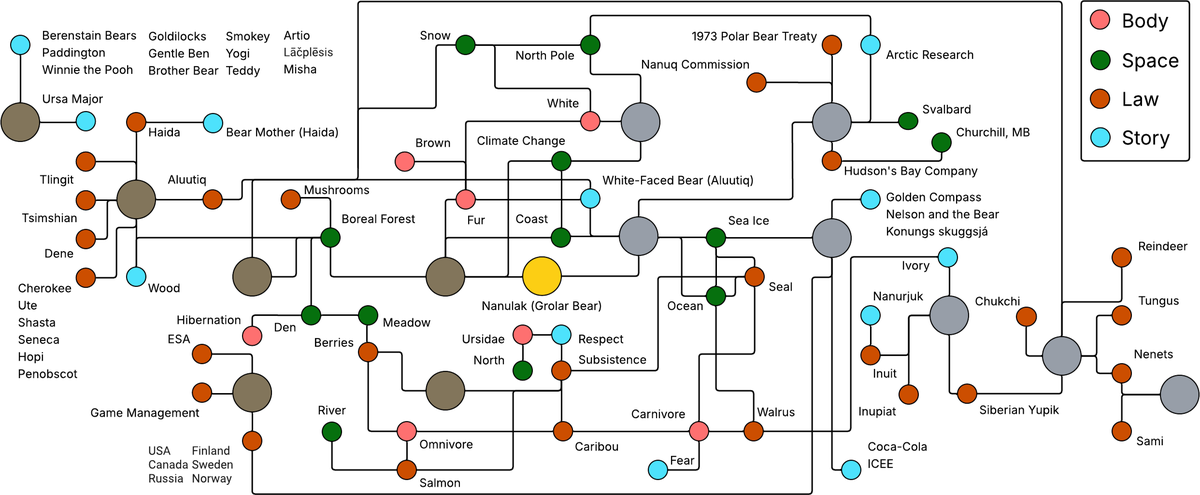
Figure 4: Conceptual assemblage of the grolar bear. This diagram represents a series of inclusions and exclusions (what would Nanulak add?), methodologically experimental and not aspiring to rigor or closure but to provocation and intimation. All elements are connected, and all categories are blurry. On the lawscape, humans and nonhumans tell stories and create laws that define space and bodies, shaping where bodies can move and thereby spread their laws and stories. The assemblage is in a state of perpetual emergence, its boundaries mutable, its shape slippery and undulating. Bodies become symbols and characters. Spaces become places and homes. The presence of a body is the presence of law, and story is embedded in place. Governance is how to navigate and preserve such interdependent multiplicity.
Hybridity as Internalized Multiplicity
As de la Cadena (2019, 480) writes, citing Haraway, ‘Species are complexly multiple, they are with what they are not… [species] “are internally oxymoronic, full of their own others… and every species is a multispecies crowd.”’ Nanulak carries ancestors and descendants in her womb, entangles inland and pelagic lawscapes, awkwardly countervails norms, and implicates every actor and institution with a stake in the Arctic. She is a charismatic multiplicity, seeking to live fully with herself and constitutive others to find her place on the tumultuous plane of spatial justice, where bodies compete for ontological belonging (Philippopoulos-Mihalopoulos 2016). She has de- and recoded her parents’ genetics and deterritorialized entire bodies of knowledge built on their separation. She slips between hunting regulations but still gets caught in their crossfire (Wiles 2016). She approaches city limits, hungry, knowing endangerment but not bound by it. She is quantified, evaluated, and tracked by scientific managers, but they don’t know what she’s up to. She is licensed to die but will reincarnate, always beset by taboos and demanding of ceremony; even her bones must be disposed of properly. She follows the laws of both salmon and seals and holds the boundary between seasonal dreamings and wakings; like bears before her, she is a mediator between worlds (Black 1998). Along with plants and fungi, she carves out a hybrid zone at the edge of the boreal shield. At once, she faces the buffets of waste and discards outside of northern Russian villages and plucks ripe berries near North American campsites with her dexterous lips. She bloodies the ice with seal and smothers her paws with prickly honey. Singular and multiple, Nanulak cannot be contained by phylogeny or phenology. She is all the stories never told about her (see Figure 4).
Like the coast, Nanulak resists easy incorporation into scientific or legal schemes. Zoologists tend to view hybrids as an aberration in their taxonomic endeavor, dismissing them as ineffective and transient (Barton 2001). Armstrong (2019, 151) intimates that the popular treatment of interspecies hybridizations as ‘unnatural’ highlights scientific preferences for maintaining order and buries their profound demonstration of life’s capacity for transformation. Indeed, if every organism is a holobiont (Gilbert 2017), including the mitochondrial genome of eukaryotes, then is hybridity not a fundamental biological condition? Aren’t species just one layer of a Russian nesting doll named Gaia? Nanulak, then, is not a hybrid of two stable organismal archetypes but a hybrid of hybrids, the fleshy, motile melding of bacteria, landscapes, and memories. Breaking free from the genetic absolutism of the term, hybridity thus proliferates rhizomatically as internalized multiplicity to:
…escape the abstract opposition between the multiple and the one, to escape dialectics, to succeed in conceiving the multiple in the pure state, to cease treating it as a numerical fragment of a lost Unity or Totality or as the organic element of a Unity or Totality yet to come, and instead distinguish between different types of multiplicity… (Deleuze & Guattari 1987, 32)
In this manner, the coast, too, is a hybrid and always has been; it is neither land nor sea, is both more and less than both, and itself doesn’t recognize the distinction. Arctic coasts, where landfast ice extends terrain deep into the High Seas and permafrost carries the coast inland, complicate categories even further (Elden 2017). For millennia, the relative mixtures of air, water, and minerals cycled reliably with the sun: a stable phenology of freeze and thaw. But with the ceaseless combustion of hydrocarbons, the phenology is degraded, the transitions uncalibrated and offset, the seasonal hybridities of coastal elements increasingly eroded, muddied, churned, and adulterated. Some things that take place on the coast are labeled as natural, while other things are labeled as artificial or anthropogenic. An oil spill is artificial. Ice gouging is natural. Drowning is artificial. A typhoon is natural. But there are events labeled natural disasters that are anything but (Howitt et al. 2012), and there are routine, legal practices that qualify as disasters (Nixon 2011). As Latour (2004) insisted, the facile divide between ‘nature’ and ‘culture’ has itself become a source of dysfunction, a scaffold upholding scientific and political hierarchies. They are categories laden with culprits, causalities, and predetermined solutions. The Arctic coastal lawscape is a mess of haphazard withdrawals and unmended ruptures that sculpt its politics. Who desires whom to occupy space? How do humans assert their spaces and territories over shifting coastal socionatures? What does the sea or the ice desire (Smith 2025)? Where and how can conflicting desires be resolved? Maybe in governance. Hybrid, polycentric, participatory, and just governance, fostered by normative conditions, rights, and obligations stemming from more-than-human needs.
Hybrid Governance of Arctic Coasts
Nanulak recedes into the distance, wandering north and south, seaward and into the foothills. She has transgressed phylogenetic boundaries and will eventually cross the invisible margins of jurisdictions in northern North America. Her back is painted with permit targets, her belly full of stolen rinds, scales, and bones, yet the laws she heralds of a warming world are absolute. She is the Anthropocene coast enfleshed. Because, as Philippopoulos-Mihalopoulis (2014, 5) describes, the movement of one body pulls a vast assemblage of other bodies with it, we can observe her journey along climatic gradients as a multispecies migration that includes northward-moving beavers (Tape et al. 2018) and salmon (Sullivan 2023), not to mention shipping vessels (each of whose ballast tanks may contain over eighty microbial and plankton species) (Wang et al. 2022), plastics (agentic waste species) (Picard et al. 2023, 6), and the mobilized metals and organics of tundra permafrost (Parlato and Madani 2024). None of these movements are isolated; none of these bodies are unaffected by the others. ‘Governing’ this region thus requires its own hybridity and multiplicity, not parochially limited to structural polycentrism or even procedural equity, but a hybrid political subjectivity conscious of the Other as self and open to its pluriversal implications, humble in its relationships to humans and nonhumans alike. Co-production and co-management among Indigenous Peoples, non-state actors, and regional governments come close (Acton et al. 2021), but must further become a worlding project (Blaser 2014) to accommodate decolonial, degrowth, and pluriversal positionings that contest Eurocentric ontologies and subjectivities (Collard et al. 2015).
Bringing hybridity to bear on the dynamic regimes governing the human use and management of Arctic coasts is important because, as Hung (2024, 3) argues, ‘locating the multiple materialities of the Earth should be the method for contextualizing the different practices and scenarios of state territorialities’. In other words, hybridity arises inherently in the co-constitution of governance, space, and materiality, which, in turn, helps to overcome commitments to the nature/culture divide in the critical area of institutionalism, opening possibilities for institutions of ‘response-ability’ that support ‘the ability of humans and animals to articulate, attune, and respond to each other’ (Brown et al. 2019). Response-ability cannot operate in arborescent hierarchies that silo and rank governance needs and so must be cultivated through rhizomatic, grassroots networks (Briassoulis 2019), breaking down troubled binaries of land-sea, human-animal, and governor-governed. The territorial nation-state, which dominates coastal lawscapes as borders, jurisdictions, and grids, must be deterritorialized before observant socio-environmental adaptation can properly begin. There are two kinds of territory at work here that articulate at physical and metaphysical levels but must be hybridized in governance. State territoriality is closely related to animal territoriality, and both are only loosely connected to the assemblage concept of territorialization. The former primarily concerns spatially bounded political sovereignty and the latter behavioral assertions of influence over space (Elden 2010), while assemblage territoriality concerns the shape and strength of relational arrangements. The processes of de- and, eventually, reterritorialization entail material semiotic openings and closures across categories, species, reigns, and domains, as well-illustrated by Deleuze and Guattari’s (1987, 10) famous example of orchid-wasp symbiosis, where both the flower and the insect self-transform in order to become internal to one another’s arrangements.
Coasts are in a constant state of de- and reterritorialization, land and water interpenetrating diversely as lagoons, marshes, estuaries, deltas, barrier islands, spits, fjords, and floodplains. Neither land nor sea can be said to initiate or define the interaction; both categories transform and assert themselves independently but always in relation to the other (Grancher and Serruys 2021; McCay 2008). Their condition is never settled but always breaks free from fixity to make itself anew. Land and water can likewise be said to de- and recode one another. Where territorialization addresses form or expression, coding addresses substance or content. For coasts, coding takes place specifically through the process of saturation, such that the geochemical composition of land infuses water at the shore, while water’s own geochemistry and fluidity come to inhere in coastal silts, sands, and soils. The total process of ‘double articulation’, involving both coding and territorializing, is known as stratification. As Deleuze and Guattari (1987, 41–45) write:
…each articulation [of an assemblage] has a code and a territoriality; therefore each possesses both form and substance. For now, all we can say is that each articulation has a corresponding type of segmentarity or multiplicity: one type is supple, more molecular, and merely ordered; the other is more rigid, molar, and organized… [But] their functional definition provides no justification for calling one, and not the other, of these entities expression, or one, and not the other, content. They are defined only by their mutual solidarity, and neither of them can be identified otherwise. They are defined only oppositively and relatively, as mutually opposed functives of one and the same function.
The strata of the state is overcoded and overterritorialized and therefore ossified and brittle. The order on which the state was founded and which it aims to perpetuate erodes at its ecosocial base. The illusion of separation is the source of its fragility. What does this mean for Arctic coastal governance in the Anthropocene? Primarily, it means that human legal acts (e.g., policy creation, jurisdictional mapping, juridical enforcement, procedure) are merely one part of the process of normatively articulating the coastal lawscape, while the latter articulation concerns the ways that diverse bodies reify, transgress, affirm, and reject the first articulation. Law, governance, is not imposed, only assembled. This process is also reversible: nonhuman legal actors articulate material conditions (e.g., territories, ecoregions, bodily hazards, food and water availabilities) that human legal acts contravene, constrict, channel, and uphold as the second articulation. Earth prompts beings to respond. The relation is somewhat dialectic, but none of its oppositions is fully binary: it is all multiplicity, moving with and against multiple directions at once. States perform and constantly reassert their territoriality through military, infrastructural, legal, and cartographic means. From a material standpoint, state territoriality differs not in kind but only in degree from nonhuman territorialities. The apparent solidity of state territory must be fundamentally challenged, its fragility exposed, and its arrangements deterritorialized to accommodate the dynamic, hybridizing territories of the Earth, its waters, and lands.
The diverse corporeal agencies enacting these movements weave together the fabric of the lawscape, not as effects of the institutionalized legal system, but as ‘emerging assemblages that, by virtue of including law or politics or other social institutions in their assembled bodies… acquire agency’ (Philippopoulos-Mihalopoulos 2014, 48). Law is then understood as ‘an expansive institutional affect that permeates the formal and the informal, the abstract and the material’ (ibid., 69). Understanding the entanglement of space and institutions in this way can help us locate Nanulak’s tracks again at some point in the future, when humans have learned to observe her at an appropriate distance and recognize that the lawscape she treads is not ours to divide and dominate. After centuries of Euro-American denial, the Earth still governs us and will demonstrate again and again the vanity of empire and its systems. The accelerating ebb and flow of the Anthropocene will not be taxonomized. Its laws of survival will not be legislated from on high. Only when understanding of governance opens to the need for response-ability, for an ethos of respect, collective action, reciprocity, and particularity of place (Collard et al. 2015; Redvers et al. 2020) does it become possible to envision abundant futures for our extended more-than-human selves. So, melt, flow, and fraternize with a multiplicity of Others. The bottom is falling out.
Notes
Competing Interests
The author has no competing interests to declare.
References
Acton, Leslie, Rebecca L. Gruby, and ‘Alohi Nakachi. “Does polycentricity fit? Linking social fit with polycentric governance in a large-scale marine protected area.” Journal of Environmental Management 290, July 2020 (2021). http://doi.org/10.1016/j.jenvman.2021.112613
Armstrong, Rachel. Liquid Life: On Non-Linear Materiality. Santa Barbara, CA: Punctum Books, 2019. http://doi.org/10.2307/jj.2353974
Barton, N.H. “The role of hybridization in evolution.” Molecular Ecology 10, no. 3 (2001): 551–568. http://doi.org/10.1046/j.1365-294X.2001.01216.x
Black, Lydia T. “Bear in human imagination and in ritual.” Ursus 10 (1998): 343–347.
Blaser, Mario. “Ontology and indigeneity: On the political ontology of heterogeneous assemblages.” Cultural Geographies 21, no. 1 (2014): 49–58. http://doi.org/10.1177/1474474012462534
Briassoulis, Helen. “Governance as multiplicity: The Assemblage Thinking perspective.” Policy Sciences 52, no. 3, (2019): 419–450. http://doi.org/10.1007/s11077-018-09345-9
Brown, Katrina M., Frode Flemsæter, and Katrina Rønningen. “More-than-human geographies of property: Moving towards spatial justice with response-ability.” Geoforum 99, April 2018 (2019): 54–62. http://doi.org/10.1016/j.geoforum.2018.12.012
Collard, Rosemary-Claire, Jessica Dempsey, and Juanita Sundberg. “A manifesto for abundant futures.” Annals of the Association of American Geographers 105, no. 2 (2015): 322–330. http://doi.org/10.1080/00045608.2014.973007
Davies, Margaret, Lee Godden, and Nicole Graham. “Situating property within habitat: Reintegrating place, people, and law.” Journal of Law, Property,and Society 6, no. 1 (2021): 1–50.
De La Cadena, Marisol. “An invitation to live together making the ‘complex we.’” Environmental Humanities 11, no. 2 (2019): 477–484. http://doi.org/10.1215/22011919-7754589
Deleuze, Gilles and Félix Guattari. A Thousand Plateaus: Capitalism and Schizophrenia. Minneapolis, MN: University of Minnesota Press, 1987.
Demuth, Bathsheba. Floating Coast: An Environmental History of the Bering Strait. New York, NY: W.W. Norton and Company, 2019.
Elden, Stuart. “Land, terrain, territory.” Progress in Human Geography 34, no. 6 (2010): 799–817. http://doi.org/10.1177/0309132510362603
Elden, Stuart. “Legal terrain: The political materiality of territory.” London Review of International Law 45, no. 2 (2017): 199–224. http://doi.org/10.1093/lril/lrx008
García Criado, Mariana, Isabel C. Barrio, James D.M. Speed, Isla H. Myers-Smith, Anne D. Bjorkman, Rien Aerts, Juha M. Alatalo, Katlyn R. Betway-May, Robert G. Björk, Mats P. Björkman, Daan Blok, Elisabeth J. Cooper, J. Hans C. Cornelissen, Sarah C. Elmendorf, William A. Gould, Ragnhild Gya, Greg H.R. Henry, Luise Hermanutz, Robert D. Hollister… Tage Vowles. “Borealization of plant communities in the Arctic is driven by boreal-tundra species.” Preprint. http://doi.org/10.32942/X2534Q
Gilbert, Scott F. “Holobiont by birth: Multilineage individuals as the concretion of cooperative processes.” In Arts of Living on a Damaged Planet: Ghosts and Monsters of the Anthropocene, edited by Anna Tsing, Heather Swanson, Elaine Gan, and Nils Bubandt, 73–90. Minneapolis, MN: University of Minnesota Press, 2017. http://www.jstor.org/stable/10.5749/j.ctt1qft070.23
Grancher, Romain and Michael W. Serruys. “Changes on the coast: Towards a terraqueous environmental history.” Journal for the History of Environment and Society 6 (2021): 11–34. http://doi.org/10.1484/J.JHES.5.128578
Haraway, Donna J. Staying with the trouble: Making kin in the chthulucene (Vol. 17). Durham, NC: Duke University Press, 2016. http://doi.org/10.1215/9780822373780
Howitt, Richard, Olga Havnen, and Siri Veland. “Natural and unnatural disasters: Responding with respect for Indigenous rights and knowledges.” Geographical Research 50, no. 1 (2012): 47–59. http://doi.org/10.1111/j.1745-5871.2011.00709.x
Hung, Po-Yi. “Gaia and the repositioning of the state territoriality: A dialogue with critical geopolitical ecology.” Dialogues in Human Geography 15, no. 3 (2024): 474–478. http://doi.org/10.1177/20438206241278726
Ingvaldsen, Randi B., Karen M. Assmann, Raul Primicerio, Maria Fossheim, Igor V. Polyakov, and Andrey V. Dolgov. “Physical manifestations and ecological implications of Arctic Atlantification.” Nature Reviews Earth & Environment 2, no. 12 (2021): 874–889. http://doi.org/10.1038/s43017-021-00228-x
Latour, B. (2004). Politics of Nature. Harvard University Press. http://doi.org/10.4159/9780674039964
MacDonald, J. (2000). The Arctic Sky: Inuit Astronomy, Star Lore, and Legend. Nunavut Research Institute.
McCay, B. J. (2008). The Littoral and the Liminal: Challenges to the Management of the Coastal and Marine Commons. Mast, 2, 7–28. http://www.marecentre.nl/mast/documents/Mast_7_1_Pizzini.pdf.
Mignolo, W. D., & Tlostanova, M. V. (2006). Theorizing from the borders: Shifting to geo- and body-politics of knowledge. Journal of Asian and African Studies, 41(3), 205–221. http://doi.org/10.1177/1368431006063333
Nixon, R. (2011). Slow Violence and the Environmentalism of the Poor. Harvard University Press. http://doi.org/10.4159/harvard.9780674061194
North American Bear Center. (2025). “Bear evolution.” North American Bear Center. https://bear.org/bear-facts/bear-evolution/.
Parlato, N. J., & Madani, Z. (2024). Water Justice in the Arctic: Indigenous Rights, Legal Challenges, and the Future of Governance Amidst Climate Change. Current Developments in Arctic Law, 12, 71–82.
Philippopoulos-Mihalopoulos, A. (2014). Spatial Justice: Body, Lawscape, Atmosphere. Routledge. http://doi.org/10.4324/9781315780528
Philippopoulos-Mihalopoulos, A. (2016). Spatial Justice in the Lawscape. Urban Interstices: The Aesthetics and the Politics of the In-Between, 87–102. http://doi.org/10.4324/9781315548807-4
Picard, M. H., Brenchat-Aguilar, A., Carroll, T., Gilbert, J., & Miller, N. (Eds.).(2023). A Bestiary of Waste. UCL Press. http://doi.org/10.14324/111.9781800085183
Polar Bears International. (2025). “The evolution of the polar bear.” Polar Bears International. https://polarbearsinternational.org/polar-bears-changing-arctic/polar-bear-facts/name-evolution/
Pongracz, Jodie D., David Paetkau, Marsha Branigan, and Evan Richardson. “Recent hybridization between a polar bear and grizzly bears in the Canadian Arctic.” ARCTIC 70, no. 2 (2017): 151. http://doi.org/10.14430/arctic4643
Redvers, Nicole, Anne Poelina, Clinton Schultz, Daniel M. Kobei, Cicilia Githaiga, Marlikka Perdrisat, Donald Prince, and Be’sha Blondin. “Indigenous natural and first law in planetary health.” Challenges 11, no. 2 (2020): 29. http://doi.org/10.3390/challe11020029
Shafer, Craig L. “Contribution of hybridization between polar bears and grizzly bears to polar bear extinction.” Wildlife Letters 1, no. 4 (2023): 178–193. http://doi.org/10.1002/wll2.12024
Smith, Jen Rose. Ice geographies: The colonial politics of race and indigeneity in the Arctic. Durham, NC: Duke University Press, 2025. http://doi.org/10.1215/9781478060758
Smith, Thomas E. L., and Felicia H. M. Liu. “Seasons and the anthropocene.” Progress in Environmental Geography 4, no. 3 (2025): 342–362. http://doi.org/10.1177/27539687251348470
Sullivan, Will. “Climate change is pushing salmon north in Alaska, scientists say.” Smithsonian Magazine. Oct 26, 2023. https://www.smithsonianmag.com/smart-news/climate-change-is-pushing-salmon-north-in-alaska-scientists-say-180983106/
Tape, Ken D., Benjamin M. Jones, Christopher D. Arp, Ingmar Nitze, and Guido Grosse. “Tundra be dammed: Beaver colonization of the Arctic.” Global Change Biology 24, no. 10 (2018): 4478–4488. http://doi.org/10.1111/gcb.14332
Wang, Zhaojun, Mandana Saebi, Erin K. Grey, James J. Corbett, Dong Chen, Dong Yang, and Zheng Wan. “Ballast water-mediated species spread risk dynamics and policy implications to reduce the invasion risk to the Mediterranean Sea.” Marine Pollution Bulletin 174 (2022): 113285. http://doi.org/10.1016/j.marpolbul.2021.113285
Wiles, Mitch. “Grolar or pizzly? Experts say rare grizzly-polar bear hybrid shot in Nunavut.” CBC. May 18, 2016. https://www.cbc.ca/news/canada/north/grizzly-polar-bear-hybrid-arviat-nunavut-1.3586738